Welcome to
Preservice Teacher Professional Noticing and Motivation to Integrate Math During Shared Storybook Reading
When we haven't taught you where to look yet — what mathematics do you see?
We study what preservice teachers spontaneously notice — mathematically — in ordinary children's storybooks, and what motivates them to turn that noticing into instruction.
01
The idea
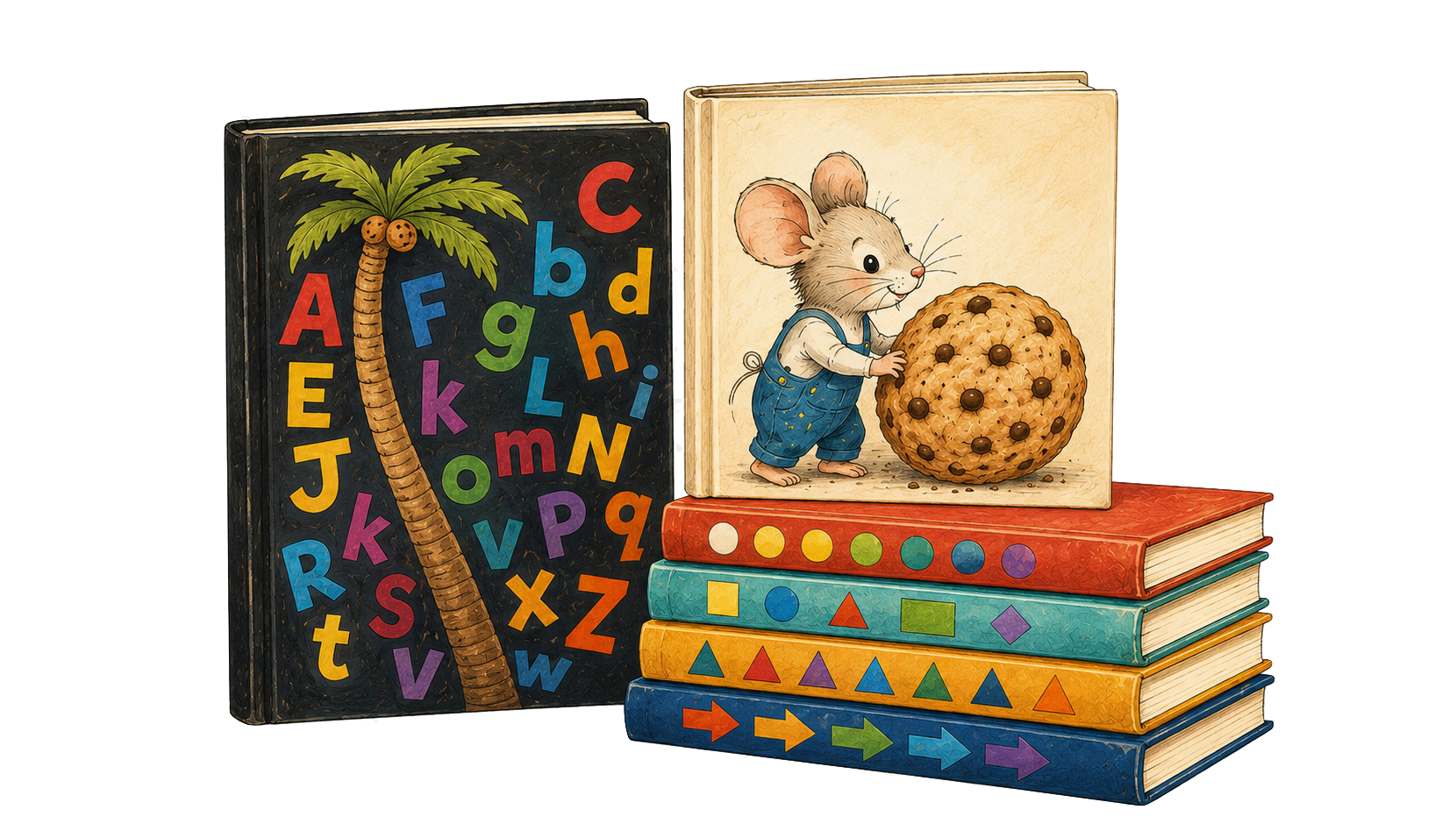
Early childhood teachers read aloud to children constantly. Every shared reading is saturated with latent mathematics — quantity, comparison, spatial reasoning, patterning, measurement — whether or not the book was written to teach math. But noticing that mathematics is not automatic, and nobody has yet shown preservice teachers where to look.
That is precisely the point of this study. Through one anonymous survey of preservice early childhood teachers at the State College of Florida, we ask what they notice on their own — and whether they feel motivated and prepared to do anything with it. The mathematical opportunities we ask about are organized around the Erikson Institute Early Math Collaborative's Big Ideas, a shared research vocabulary for early mathematics.
02
Two commitments that set this study apart
Spontaneous noticing, not taught noticing
Prior interventions — most notably Jett (2018) — explicitly taught preservice teachers to find mathematics in literature using organizers, KWL charts, and Frayer models. We deliberately withhold that instruction at the outset: our first question is what teachers see before anyone shows them where to look.
Ordinary storybooks, not math-themed books
A title like If You Were a Fraction announces its mathematics. We read ordinary children's literature whose purpose is a story — and ask whether teachers can notice the mathematical opportunities hiding in plain sight.
03
Noticing is only half the question
Seeing mathematics in a story is not the same as deciding to teach it. The study also examines motivation to act: whether self-efficacy and beliefs about the importance of early mathematics predict a teacher's intention to build on the mathematical opportunities they notice in a shared reading.
04
Where this leads
This survey establishes the baseline for a planned follow-up: pre-noticing → intervention → post-noticing. First document what teachers notice naturally; then explicitly teach mathematical noticing during shared reading; then measure whether the quantity, variety, and sophistication of what they notice changes. If noticing is teachable, teacher education gains a low-cost, high-joy lever hiding inside the read-aloud teachers already do.